AI
AI and data that create real impact
95% of AI pilots deliver no measurable impact. The cause is rarely the model – it's the data underneath it. Here's how to build the foundation that makes AI answers reliable.

In short
- The problem is rarely the model. It's the data underneath – unstructured, undefined and scattered across systems and spreadsheets.
- The numbers: MIT's study The GenAI Divide (2025) found that 95% of the AI initiatives reviewed produced no measurable impact on results. Gartner expects 60% of AI projects lacking AI-ready data to be abandoned through 2026.
- The solution: a semantic model where business concepts are defined once and used by both reports and AI.
- In practice: Vellox MCP connects Claude or ChatGPT directly to your model – read-only access, controlled permissions, traceable figures.
- Time required: with ready-made integrations to Business Central, Jeeves, Monitor, Pyramid and Visma Business, most organisations are up and running in weeks, not quarters.
AI as a catalyst – but the impact lies in the data
AI is fundamentally changing how businesses work, create value and compete. Used correctly, it raises both the pace and the quality of decisions that previously took days of manual groundwork. But real impact takes more than technology.
We see the same pattern at company after company: the AI tools are already in place. Employees use them every day to summarise text, draft documents and clear the inbox. What's missing is the connection to the organisation's own numbers. As soon as the question concerns the business itself – which customers are we losing, what has happened to the margin, how does inventory look – the AI has nothing to work from and starts guessing.
The difference between a pleasant experiment and something that actually changes how people work almost always lies in the data underneath. Not in which model you chose.
Why most AI initiatives stall
The fact that most AI investments never take off isn't just our gut feeling – it's well documented.
95 percent with no measurable impact
MIT's NANDA initiative reviewed just over 300 AI initiatives in the report The GenAI Divide: State of AI in Business 2025. The conclusion: despite an estimated USD 30–40 billion in investment, 95% of the initiatives reviewed produced no measurable impact on the income statement, while only 5% created significant value. The authors don't point to model quality as the cause, but to the gap between tools and real workflows (Forbes on the MIT report). One caveat: the figure applies specifically to measurable impact on results, and many pilots lacked a baseline to compare against. It should be read as most initiatives not being possible to substantiate – not as AI not working.
Gartner puts its finger on the same issue from the data side. In a survey of 248 data leaders, 63% said they either lack the right data management for AI or are unsure whether they have it, and Gartner predicts that through 2026 organisations will abandon 60% of AI projects that are not supported by AI-ready data (Gartner, February 2025).
What the underlying data looks like in most organisations
The pattern holds true in reality. An AI answer is never better than the data it's built on, and in most organisations that data looks roughly like this:
- the business data sits in the ERP system, in tables built for transactions
- key concepts lack a shared definition, so "revenue" means different things
- parts of the truth live in spreadsheets that act as master data
- history is incomplete, because the system overwrites instead of preserving
Connect an AI assistant straight to an environment like that and you get answers that sound good but don't hold up. And an answer that sounds good but is wrong is more dangerous than no answer at all – it's rarely discovered until someone has made a decision based on it.
That's why we argue that the AI question is fundamentally a data question. The order matters: structure first, prompt second.
From AI experiment to scalable value
The path there doesn't have to be long, but it does have to be the right one. In short, it's about:
- gathering the business data from the systems where it actually originates
- defining the concepts once, so that everyone calculates margin the same way
- quality-assuring the KPIs in a model that both reports and AI read from
- opening up the model to AI, instead of letting the AI dig through raw tables
- controlling access, so that each user only sees what they should see
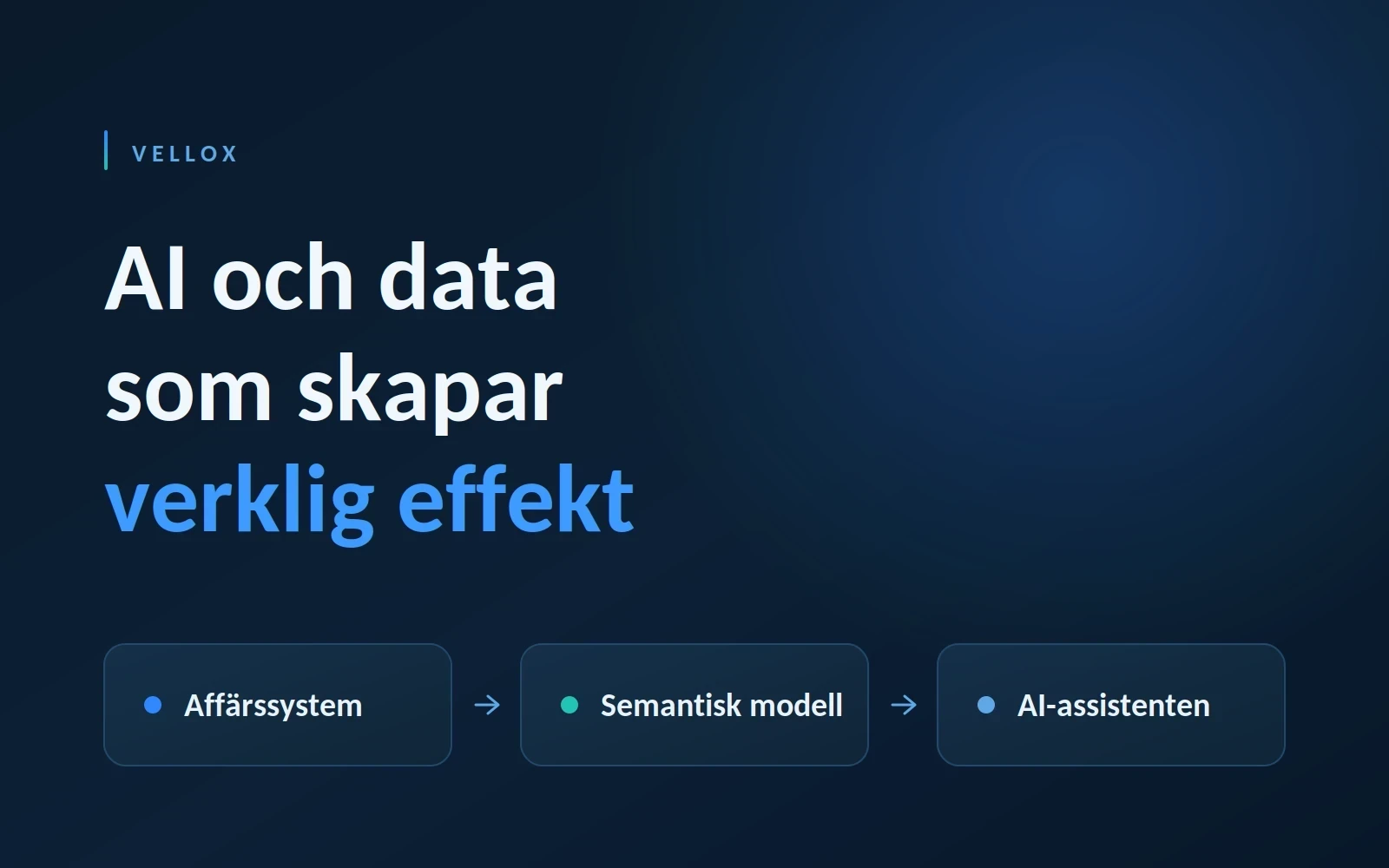
That's exactly the sequence Vellox is built for. Your data is retrieved from the ERP system, structured into a semantic model and then used by both your reports and your AI assistant. Same figures, same definitions, no matter where the question is asked.
How we can help you
1. Lay the foundation – a semantic model of your business
We pull data directly from Business Central, Jeeves, Monitor, Pyramid or Visma Business and structure it in the Vellox data warehouse. The model covers sales, purchasing, inventory, production and finance, and it comes pre-configured for your ERP system from day one.
2. Prompt your data
With Vellox MCP, Claude or ChatGPT connects directly to your semantic model. The assistant understands your modules and KPIs and retrieves current figures instead of guessing. Questions that previously required an analyst and a few hours are answered in seconds – with a basis you can go back to and review.
3. Build your own on top
Our REST API serves the same verified data that powers Vellox modules. That makes it possible to build customer portals, embedded dashboards, automations and your own AI agents without building a new data foundation for every initiative.
4. Keep it responsible
AI against operational data raises reasonable questions about security and governance. The connection to Vellox is read-only – no write operations are possible – and you decide which parts of the model are exposed and to whom. With the EU AI Act in place, it also becomes increasingly important to be able to show where an answer comes from. A model with traceable definitions makes that question easy to answer.
5. Make it part of everyday work
The value emerges when the controller, the sales manager and the production manager ask the questions themselves. We help with the first use cases, show how to ask and make sure the answers turn into decisions rather than yet another report no one opens.
What it looks like in practice
A few examples of questions our customers put directly to their own data:
- Which ten customers did we lose the most revenue from last quarter?
- How much of our suppliers' price increases have we passed on to customers?
- Which items are tying up capital in inventory without having moved in six months?
What makes the answers useful isn't that they arrive quickly. It's that they're based on the same figures as the management report – and that whoever gets the answer can ask the follow-up question straight away instead of ordering a new analysis.
Want more examples to try right away? We've put together ten questions you can ask your own business data.
Start at the right end
If AI feels like something that ought to deliver more than it does today, the model is rarely the problem. More often, it simply has nothing to work with.
Book a demo and we'll show you how Claude or ChatGPT answers questions about your specific business – using your own data. If you have a question before then, feel free to get in touch directly.
Frequently asked questions about AI and business data
Why isn't it enough to connect ChatGPT directly to our ERP system?
An ERP system is built for transactions, not for analysis. The tables lack business logic, and the same concept is calculated differently depending on which table you start from. An AI assistant reading raw tables has to guess how margin, revenue or inventory value should be calculated – and the guess isn't visible in the answer. With a semantic model, the calculation is already defined and verified.
What is a semantic model?
A layer between the ERP system and the person asking the question, where tables, relationships and KPIs are defined once. "Invoiced revenue" means the same thing in the management report as in the AI answer, because both read from the same definition. Vellox modules are exactly such a model, pre-built per ERP system.
Can the AI change anything in our ERP system?
No. The connection is read-only. No write operations are possible via Vellox MCP or our API.
How are permissions controlled?
You decide which parts of the model are exposed and to whom. Permissions follow the user, so that a salesperson and a finance director get different answers to the same question when they should.
Which ERP systems do you support?
We have ready-made integrations to Business Central, Jeeves ERP, Monitor ERP, Pyramid Business Studio and Visma Business, among others, as well as complementary sources such as PIM, WMS and web analytics systems. The full list is available on our integrations page.
How long does it take to get started?
Because the modules are pre-configured per ERP system, no large integration project is needed. Most customers see their first reports within a few weeks. Here's how it works.
Sources
- Challapally, A., Pease, C., Raskar, R. & Chari, P. (2025). The GenAI Divide: State of AI in Business 2025. MIT NANDA. Referenced via Forbes, 26 August 2025.
- Gartner (2025). Lack of AI-Ready Data Puts AI Projects at Risk. Press release, 26 February 2025.
- European Commission. Regulatory framework on AI (the AI Act, Regulation (EU) 2024/1689).